Showing posts with label #MOISTURE. Show all posts

Sunday, November 16, 2014

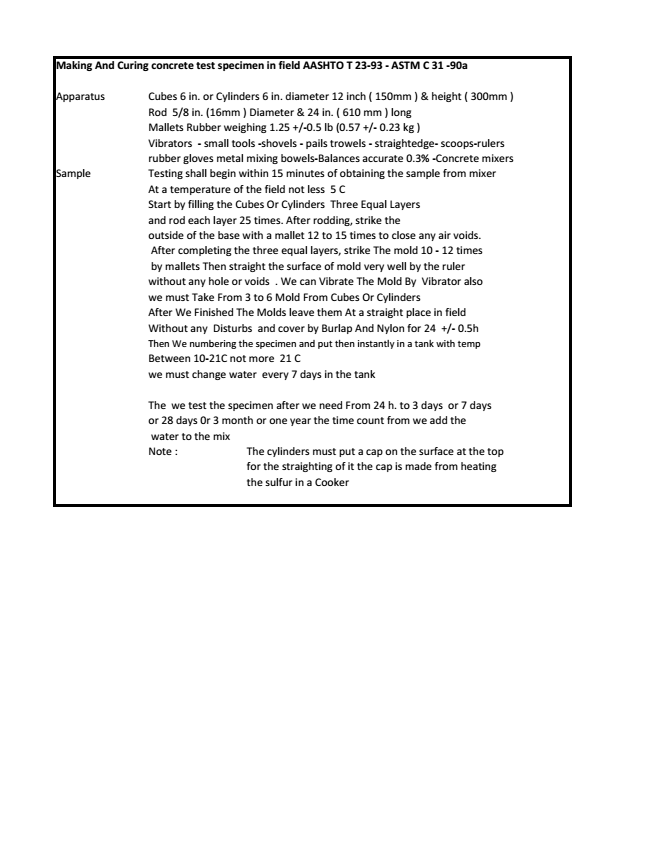
M.test#4 Making and curing concrete test specimen in lab AASHTO T 126-93


M.Test#4: Making and curing compressive test specimen in lab AASHTO T 126-93

This test method covers procedures for making and curing test specimen of concrete in laboratory under accurate control of materials and test conditions using concrete that can be consolidate by rodding or vibration as described here

Thursday, October 30, 2014

S.test #5#6#7 Atterberg Limit : Liquid Limit - Plastic Limit - Plasticity Index


Atterberg limit contains 3 tests ( liquid limit , plastic limit , plasticity limit)

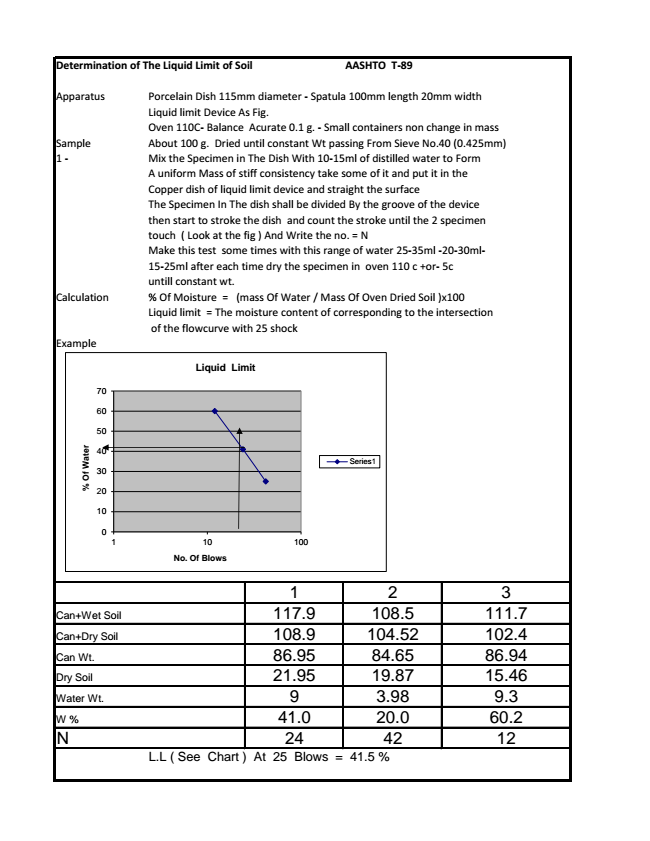
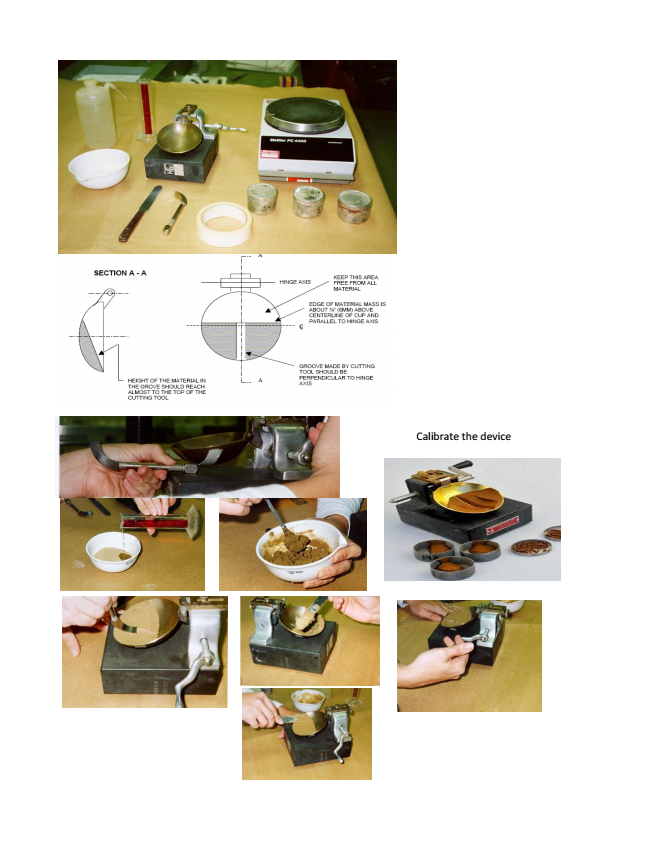
S.test #5 Determination of the Liquid limit of soil AASHTO T-89 (Atterberg limit)


This procedure covers the determination of the liquid limit of soil .It covers the change of soil from elasticity position to liquid position .


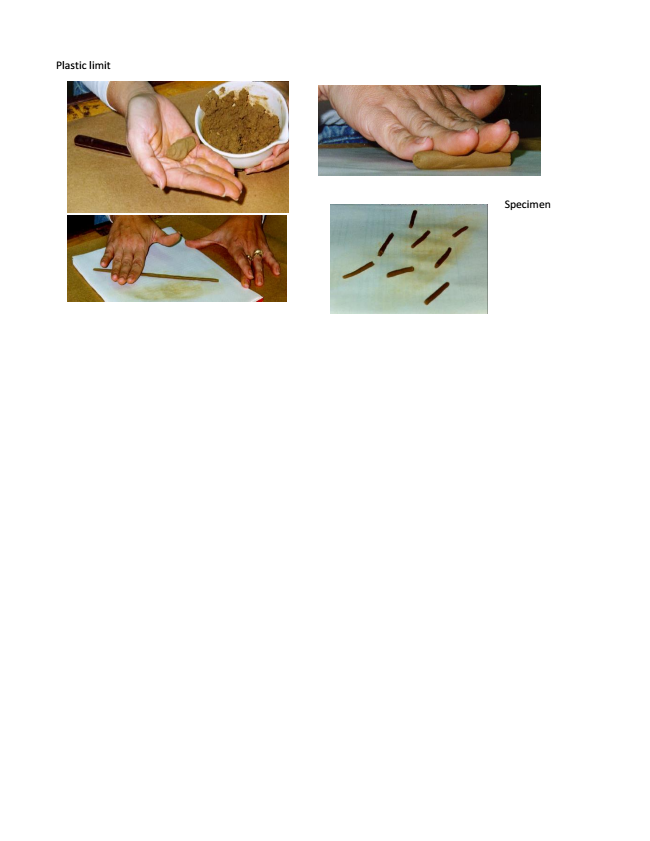
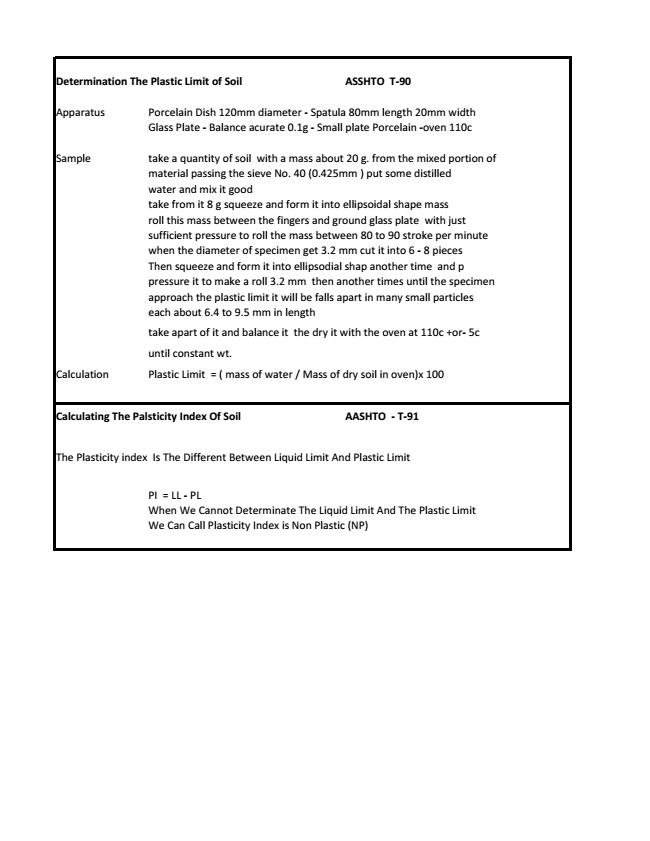
S.test#6: Plastic Limit AASHTO T - 90 (Atterberg Limit)

The plastic limit of a soil is the lowest water content at which soil remains plastic 

S.test#7 Plasticity index AASHTO T-91 (Atterberg limit)
The plasticity index of a soil is the numerical difference between the liquid limit and the plastic limit.It's the moisture content at which the soil is in a plastic state 


Monday, October 27, 2014

S.test#2: Moisture Content In Soil


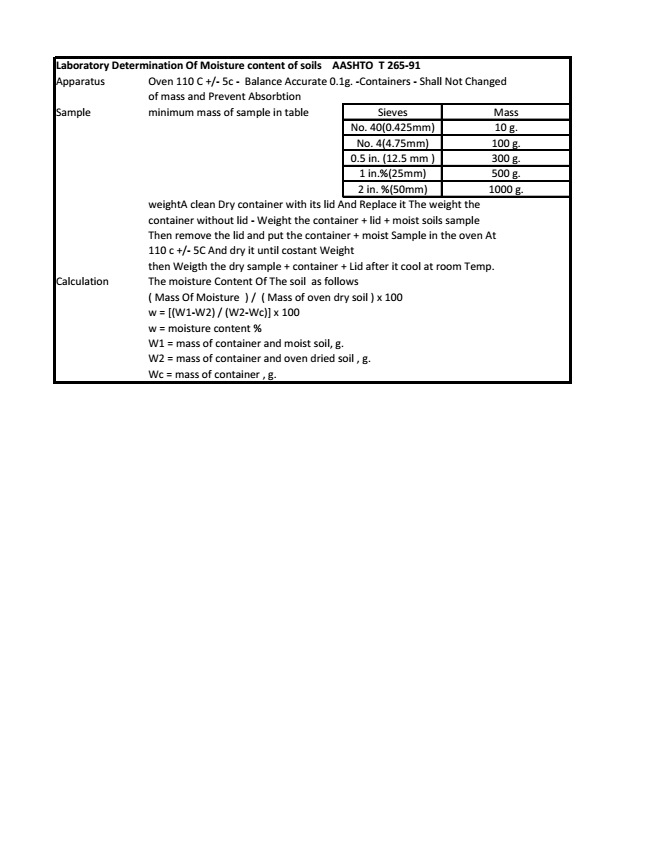
S.test#2: Laboratory Determination of moisture content of soil AASHTO T265-91


This procedure is used to determine the total moisture content of a soil . The soil is dried to remove all free moisture . This test measures the weight of the moisture removed from the soil .

Thursday, October 23, 2014

test#13 Soundness of aggregate ASTM c - 88


Test #13 Soundness of aggregate by sodium sulfate ASTM C - 88


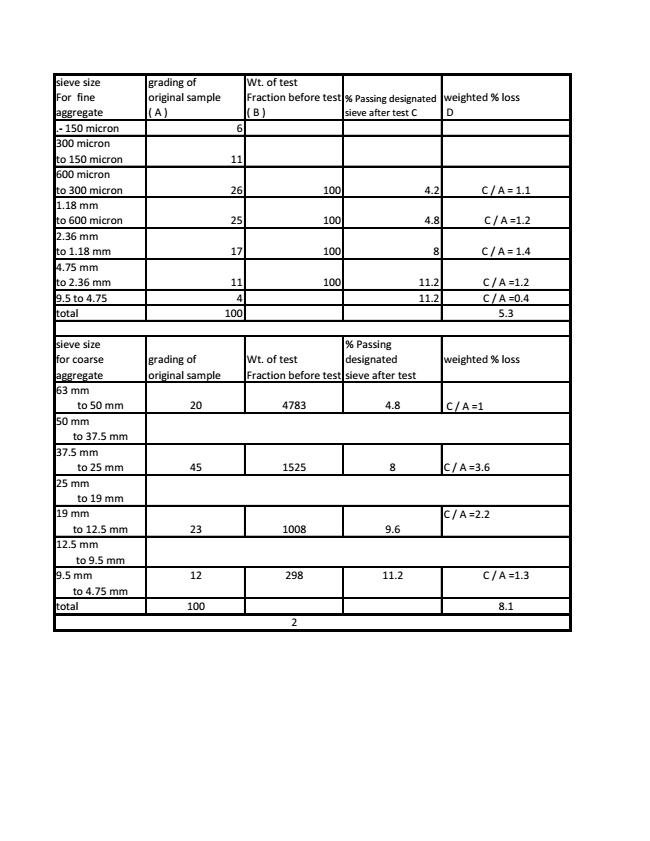
This test method covers the testing of aggregates to estimate their soundness when subjected to weathering action in concrete by repeated immersion in saturated solution of sodium or magnesium followed by oven drying 


Monday, October 20, 2014

Test#12 Material Finer 75 Micron Sieve (ASTM C117-90)


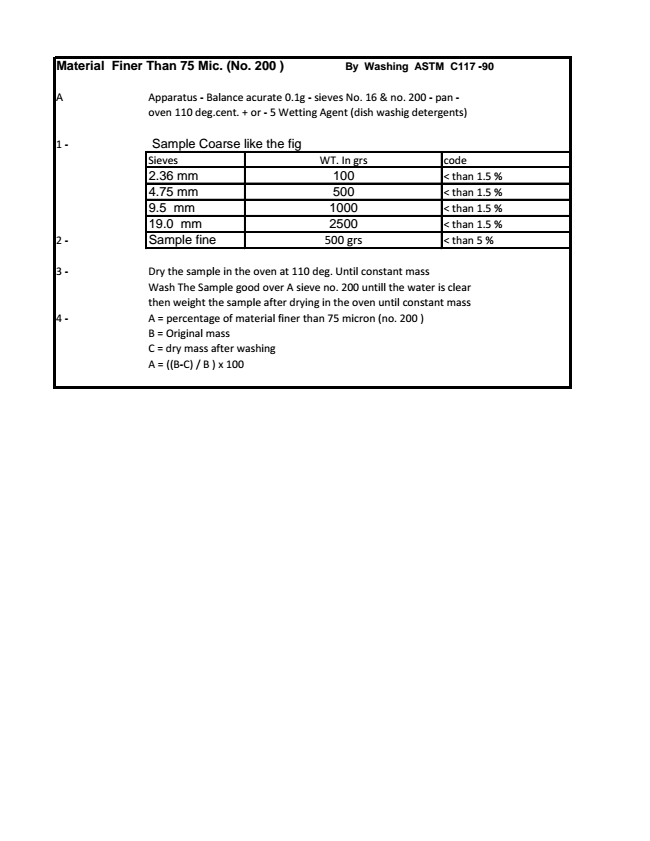
Material finer than 75mi (ASTM C 117-90)


This test method covers determination of the amount of material finer than 75 micron ( No. 200) sieve in aggregate by washing clay particles and other aggregate particles that are dispersed by the wash water  as well as the water soluble materials , will be removed from aggregate during test 


Saturday, October 18, 2014

Test#11 Fineness Modulus


Determination of fitness modulus on fine aggregate (AASHTO M6)


Fitness Modulus results from a calculation on using data from a sieve analysis. The sieves used for sand are typically  the 0.15mm (No.100) 0.30 (No.50) , 0.60mm(No. 30 ) , 1.18mm (No.16) , 2.36mm (No.8) and the 4.75mm (No.4)


Friday, October 17, 2014

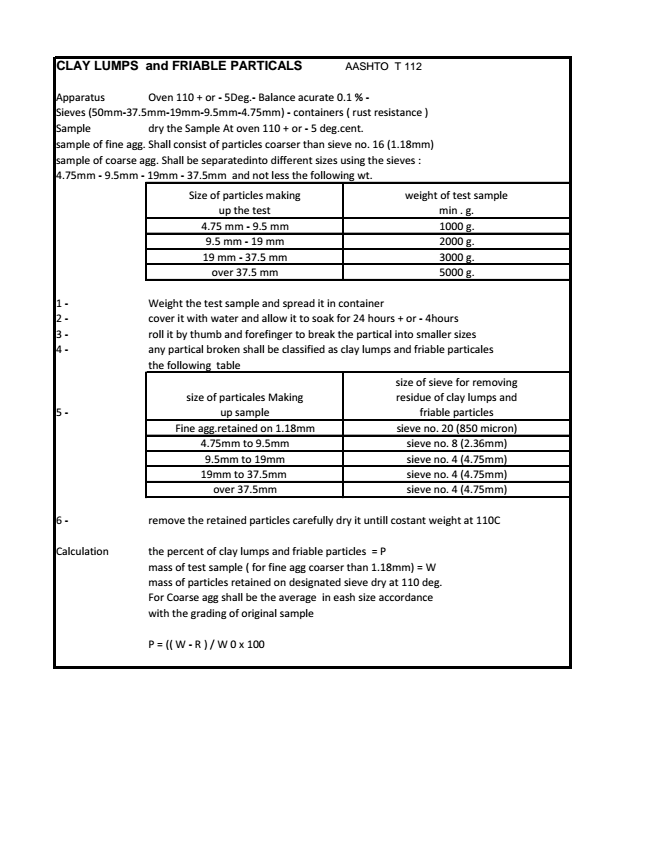
Test#10: Clay Lumps and friable particles (AASHTO T 112 - ASTM C 142)


Clay Lumps and friable particles (AASHTO T 112 - ASTM C 142)


This test method covers the approximate determination of clay lumps  and friable in natural aggregates 

Thursday, October 16, 2014

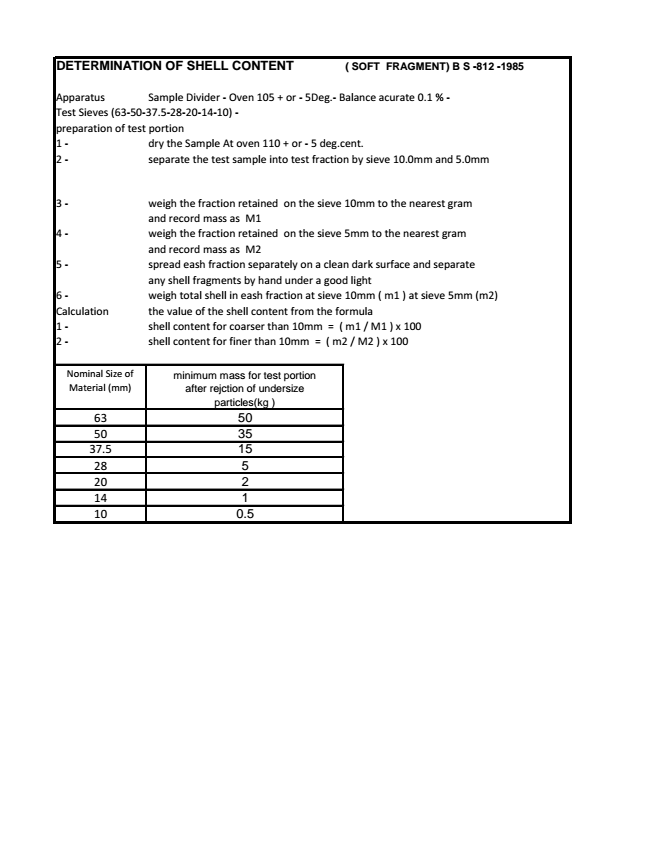
Test#9: Determination of Shell Content


Determination of Shell Content ( soft fragment BS - 812 - 1985)
This test method describes the determination of shell content of coarse aggregate 


Wednesday, October 15, 2014

Test#8: Coal And Lignite (AASHTO T 113) Lightweight pieces in aggregate ASTM C123


Coal & Lignite ( AASHTO T 113 ) Lightweight pieces in aggregateASTM C123
This test method covers the determination of the percentage of light weight pieces in aggregate  by mean of sink float separation in a heavy liquid of suitable specific gravity 

Test#7: Flakiness And Elongation in accordance to BS 812-1975


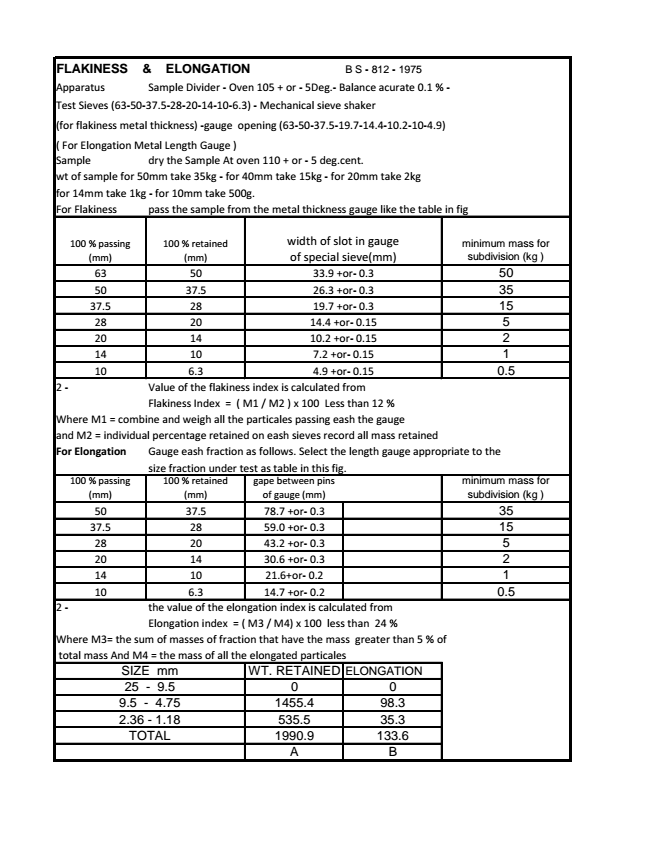
Test#7 : Flakiness and Elongation in accordance to BS 812-1975
-This test method describes of the flakiness index of coarse aggregates that are classified as flaky when they have a thickness  less than 0.6 of their mean size.
-This test method also describes the determination of the elongation of the coarse aggregates that are classified as elongated when they have a length of more than 1.8 of their mean sieve size


Tuesday, October 14, 2014

Test#6: Organic Impurities in Sand ( AASHTO T21/ASTM C40)

Organic impurities in sand (AASHTO T21/ASTM C40)
The method provides a good estimate of this type of organic matter , and when the soil contains only this type, it can also provide a good estimate of the total organic content.
However the reagents used to react only very slightly with fresh plant materials such as wood , roots , and weed tops etc.., or with hydrocarbons , charcoal, lignite, coal and the organic remains in ancient sediments. If such materials are present, and the total organic matter is to be determined , then the "LOSS ON IGNITION" T 267 method must be used 

Test#5: Los Angeles abrasion test in accordance with ( AASHTO T96-ASTM C 131)


 Los Angeles  abrasion test in accordance  with (  AASHTO  T 96 - ASTM C 131 )

This method covers the procedure for testing crushed rock, slag and gravel and uncrushed gravel for resistance to abrasion using the Los Angeles testing machine .The Los Angeles Rattler test is a measure of degradation of mineral aggregates of standard gradings resulting from a combination of actions including abrasion or attrition,impact,and grinding in a rotating steel drum containing a specified number of steel spheres (dependent upon the test sample"s grading).
As the drum rotates , a shelf plate picks up the sample and the steel spheres, carrying them around until they are dropped to the opposite side of the drum,causing an impact-crushing effect.The contents then roll withi the drum with an abrading and grinding action until the shelf plate impacts and the cycle is repeated.After the prescribes number of revolutions,the contents are removed from the drum and the aggregate portion is sieved to measure the degradation as percent loss.

Monday, October 13, 2014

Test#4: Moisture Content


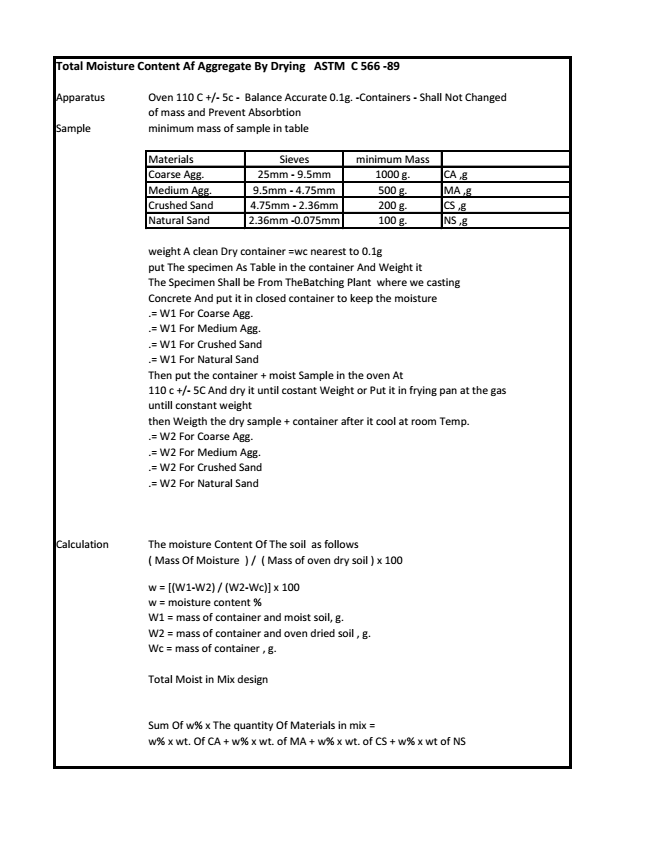
Total Moisture Content Af Aggregate By Drying   ASTM  C 566 -89

This test method covers the determination of the percentage of evaporable moisture in a sample of aggregates by drying in hardened concrete